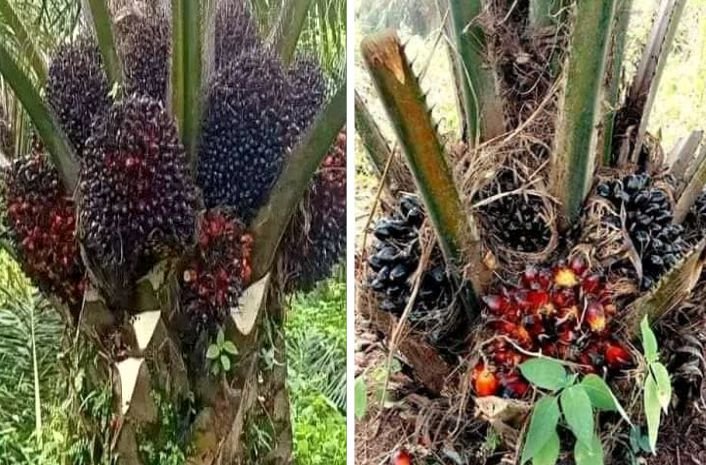
The old palms in Ntigha grow tall and thick-shelled, while the ones my father planted bear fleshy fruit with thin nuts. The two kinds even give oil of a different color, which buyers in the market notice at once. Knowing the types of palm oil trees explains that difference, and it matters long before anyone plants a seed.
Every oil palm grown for oil belongs to one of a few types, and the type largely sets how much oil each bunch gives.
The difference comes down mostly to the shell around the nut, which a single gene controls.
We break down dura, tenera, and pisifera in full, then the American oil palm, its hybrids and the rarer fruit forms.
We also show how to tell the types apart with a knife, and what my own family learned from growing both kinds.
The research comes from published studies, while the Ntigha details come from my own farm and trade.
Looking for pure, unstored red palm oil straight from a family farm in Abia State? You can buy farm fresh red oil on the shop page today.
Table of Contents
What Are the Types of Palm Oil Trees?
The types of palm oil trees are the forms of oil palm grown for oil, grouped mainly by the shell around the nut. The African oil palm, Elaeis guineensis, has three fruit forms called dura, tenera, and pisifera.
Dura has a thick shell, pisifera has none, and tenera, a cross between the two, has a thin one.
A second species, the American oil palm, Elaeis oleifera, is grown mostly for breeding hybrids.
Fruit can also be grouped by color, and a few rare forms differ in their leaves, fruit, or flowering.
The palm itself, from roots and trunk to fronds and crown, is profiled in the oil palm tree up close.
The Three Fruit Forms at a Glance
A 2021 review in the journal OCL reproduces fruit form figures first compiled by Sambanthamurthi and colleagues in 2009. They show how much more oil-bearing pulp a tenera fruit carries than a dura fruit.
| Feature | Dura | Tenera | Pisifera |
|---|---|---|---|
| Shell thickness | 2 to 8 mm | 0.5 to 4 mm | No shell |
| Fiber ring in the pulp | Absent | Present | Absent |
| Pulp as share of fruit | 35 to 55 percent | 60 to 96 percent | About 95 percent |
| Kernel as share of fruit | 7 to 20 percent | 3 to 15 percent | Not given |
| Oil to bunch | About 16 percent | About 26 percent | Bunches seldom ripen |
That gap, about 26 percent oil to bunch against 16 percent, is why commercial growers worldwide now plant tenera seed.
The layers inside each fruit, from skin to pulp, shell and kernel, are set out in layers of the palm fruit.
Why the Shell Decides Everything
A 2013 study in the journal Nature traced shell thickness to a single gene, which the researchers named SHELL. It describes dura as thick-shelled, pisifera as shell-less and tenera as thin-shelled.
The authors state that tenera yields far more oil than dura and forms the basis of commercial production across Southeast Asia.
Breeders had known since 1941 that one gene controlled the shell, but the 2013 study finally identified it.
Each tenera palm carries one dura copy and one pisifera copy of the gene. Its own seeds therefore do not breed true, and uncontrolled seed from a tenera palm gives a mixed crop.
| Cross | What the seedlings become |
|---|---|
| Dura mother with pisifera pollen | All tenera, the cross seed gardens use |
| Tenera with tenera | About a quarter dura, half tenera and a quarter pisifera |
| Tenera with dura | About half dura and half tenera |
| Dura with dura | All dura |
This is why seedlings sprouting under agric palms are a gamble, even when the parent palm yields well. A farmer who transplants them may end up with many dura and some barren pisifera palms.
Dura Palm Tree
Dura is the thick-shelled form of the African oil palm and the oldest source of palm oil in the world.
It still covers most of the wild groves of West and Central Africa, including my own corner of Abia State.
Where Dura Comes From
FAO’s guide to small-scale palm oil processing in Africa notes that wild groves across Central and West Africa consist mainly of this thick-shelled type. For generations, grove dura supplied nearly all the oil traded out of the region.
Asia’s plantations also began with dura, from just four seedlings planted at the Bogor Botanic Gardens in Java in 1848.
A breeding summary from Applied Agricultural Resources, drawing on Soh and colleagues, traces the Deli dura population to those palms.
The same summary says Deli dura served as the commercial planting material for Far East plantations from 1911 until the early 1960s.
Its descendants remain the mother palms behind much of the world’s tenera seed today.
Dura Fruit, Bunch and Tree Traits
A 1972 article in Principes, the journal of the International Palm Society, describes African dura fruit as spherical and thick shelled. It gives fruit lengths of about 2 to 5 cm and weights of about 3 to 30 grams.
- Shell. Thick and hard, about 2 to 8 mm, wrapped around a large kernel.
- Pulp. A thin layer, about 35 to 55 percent of the fruit by the 2021 figures.
- Bunch. Spikelets end in long, sharp spines, which makes harvesting and handling painful.
- Tree. Grove dura grows tall and dense, which makes the bunches hard to reach as the palms age.
- Deli dura. The Asian line carries larger fruit with a very thick shell and shorter spines.
Dura Oil and Kernel Yield
Dura gives about 16 percent oil to bunch, far below tenera, because so much of each fruit is shell. Its large nuts, however, hold a bigger kernel share, about 7 to 20 percent of the fruit.
That kernel share made dura groves a steady source of kernels for village kernel oil and for export. The oil those kernels give, and how villages make it, is profiled in oil pressed from palm kernels.
Dura in Abia State, Nigeria
The old palms that grew on their own across my family’s land in Ntigha are this kind. Nobody planted them, and they have been harvested by my family for generations.
Their nuts are hard and thick, which made cracking kernels by hand slow, tiring work for my family.
Their oil, in my experience as a producer, comes out the deep red that local buyers look for.
Dura in Breeding
Selected dura palms serve as the mother trees for every tenera seed produced today. Breeders pick mothers with heavy bunches and good oil content, then pollinate them with pisifera pollen.
| Dura strengths | Dura weaknesses |
|---|---|
| Hardy, long-lived, and common in wild groves | Lowest oil to bunch, about 16 percent |
| Large kernels for kernel oil | Thick shells that are hard to crack |
| Mother palm for all tenera seed | Tall growth that makes harvesting harder |
| Deep red oil prized by local buyers, in my experience | Spiny bunches that are painful to handle |
Tenera Palm Tree
Tenera is the thin-shelled hybrid of dura and pisifera, and it is the palm behind nearly all commercial palm oil today. In Abia and much of southern Nigeria, people simply call it the agric palm.
How Tenera Was Discovered
Tenera palms first drew attention in the Congo, where local people called the thin-shelled fruit Lisombe, according to the 1972 Principes article.
Belgian researchers Beirnaert and Vanderweyen showed in 1941 that it was a cross between dura and pisifera.
That finding changed the industry, because breeders could now produce tenera seed on demand by crossing the two parents. Plantations in Africa, Asia and Latin America switched to tenera over the following decades.
Tenera Fruit and Tree Traits
The Principes article describes tenera fruit as elongated or ovoid, with a thin shell and far more oil bearing pulp than dura.
A dark ring of fibers sits in the pulp around the shell, and dura lacks it.
- Shell. Thin, about 0.5 to 4 mm, around a small kernel.
- Pulp. Thick and fleshy, about 60 to 96 percent of the fruit.
- Fiber ring. Present in the pulp near the shell, the surest sign of tenera.
- Tree. A thicker, shorter trunk than grove dura, with larger leaves.
- Seed. A hybrid that does not breed true, so new seed must come from controlled crosses.
Tenera Oil Yield
Tenera gives about 26 percent oil to bunch in the breeding figures, against about 16 percent for dura.
A 2016 study in Frontiers in Plant Science states that commercial tenera palms typically yield 30 percent more oil than dura.
The higher yield comes almost entirely from the thicker pulp, since every fruit holds less shell and more oil. Kernel output falls a little, but the extra palm oil more than makes up for it.
How Tenera Seed Is Produced
Seed producers pollinate selected dura mothers with pollen from selected pisifera fathers, then cover the flowers to block stray pollen. Every seed from that controlled cross should grow into a true tenera palm.
In Nigeria, the National Oil Palm Research Institute, NIFOR, produces this kind of seed for farmers and state programs. Raising sprouts from improved nuts is covered step by step in germinating improved palm seed.
The Problem of Contaminated Seed
Seed that should be pure tenera sometimes carries dura or pisifera, from stray pollen or careless seed handling.
The same 2016 Frontiers study tested independent oil palm farms across Malaysia with a SHELL gene test.
It found about 10.9 percent of palms were not tenera, with 8.1 percent dura and 2.8 percent pisifera.
Some sites reached 63.5 percent contamination, and the study valued the national loss at about RM 1.05 billion a year.
Contaminated palms look normal for years, so farmers only discover the loss once the palms bear fruit. Buying certified seed from a trusted source is the only real protection against this loss.
Agric Palms in Abia State
My father planted agric palms on purpose beside the wild groves he inherited. He bought the seedlings from sellers and, most of the time, from agricultural education institutions.
His agric palms bear fleshy fruit with small, thin nuts, which matches what the research describes for tenera.
Their oil, however, looks quite different from the oil of the wild palms.
Why Agric Palm Oil Looks Yellower
In my experience as a producer and seller, oil from agric palms comes out yellowish rather than the deep red of wild palm oil.
The taste stays the same, but the color in the pot is clearly lighter.
Cooks notice it most in egusi and ogbono soups, where they need more agric palm oil to reach that familiar red.
For that reason, the customers I deal with naturally lean toward oil from the old wild palms.
Some retailers now blend oil from both kinds of palm to reach a middle ground between the two colors.
Blending two genuine palm oils is not adulteration, which means adding dye or foreign oil.
Older research points the same way as my experience, though the evidence is thin. The 1972 Principes article reports that the fruit of grove palms carries more carotene in its oil than plantation palms.
Grove palms are mostly dura and plantation palms mostly tenera, but that study did not compare the two fruit forms directly.
Modern figures comparing carotene in dura and tenera oil remain scarce, so treat this as a likely pattern, not a proven rule.
The pigments behind red oil, and why refining strips them out, are covered in the deep color of red oil.
| Tenera strengths | Tenera weaknesses |
|---|---|
| Highest oil to bunch, about 26 percent | Seeds do not breed true |
| Thick pulp and thin, easily cracked shells | Needs certified seed from controlled crosses |
| Shorter trunk, so bunches stay within reach longer | Seed contamination can go unseen for years |
| Planted by nearly every commercial grower | Oil looks lighter than grove oil, in my experience |
Pisifera Palm Tree
Pisifera is the shell-less form of the African oil palm, and farmers almost never plant it for oil. Its real value lies in its pollen, which makes tenera seed possible.
Pisifera Fruit and Bunch Traits
Pisifera fruit has no shell at all, only a small, pea like kernel wrapped in fiber and pulp. The pulp makes up about 95 percent of the fruit, the highest share of any form.
The catch is fertility, because most pisifera palms are female sterile and bear little fruit. The 2016 Frontiers study notes that their bunches typically rot before they produce oil.
- Shell. None at all, so each small kernel sits loose in the fiber.
- Kernel. Small and pea like in the rare fruit that do develop.
- Bunches. Few and small, and most of them rot before they ripen.
- Breeding. Fertile pisifera crossed with pisifera breeds true, according to the Principes article.
Pisifera in Seed Production
Seed gardens keep selected pisifera palms as fathers, collecting their male flowers for pollen. That pollen is then dusted onto the flowers of dura mothers to make tenera seed.
A good pisifera father passes on traits such as bunch weight and oil content to the seed.
Breeders judge each father by the tenera palms its pollen produces, not by its own poor bunches.
Pisifera on a Farm
A pisifera palm in a commercial field is a sign of uncontrolled seed. It grows vigorously, takes up space and fertilizer, and returns very little oil.
Growers can remove such palms once they reach bearing age and their barren, rotting bunches show. A SHELL gene test can now spot them as seedlings, before they waste years of care.
| Pisifera strengths | Pisifera weaknesses |
|---|---|
| Father palm for all tenera seed | Mostly female sterile |
| Highest pulp share, about 95 percent | Bunches rot before ripening |
| Vigorous growth | Takes up land and fertilizer for little oil |
How to Tell Dura, Tenera and Pisifera Apart
You can tell the three forms apart by cutting a ripe fruit across the middle with a sharp knife.
| What to look at | Dura | Tenera | Pisifera |
|---|---|---|---|
| Shell | Thick, about 2 to 8 mm | Thin, about 0.5 to 4 mm | None |
| Pulp | Thin layer around a large nut | Thick, fleshy layer around a small nut | Nearly all pulp, tiny kernel |
| Fiber ring | Absent | Present near the shell | Absent |
| Feel of the fruit | Hard and woody | Soft and fleshy | Soft, if the fruit ripens at all |
| Bunches | Normal, spiny | Normal, heavy | Few, rotting |
Back home, farmers judge the same way, by how fleshy the fruit is and how thin the nut feels.
The fiber ring is the surest sign, since shell thickness overlaps a little between dura and tenera.
Fruit Color Forms
Fruit color is a separate trait from shell type, so a dura or tenera palm can carry any of these colors.
The Principes article describes three main color forms of the African oil palm.
Nigrescens
Nigrescens is the ordinary, common form, with unripe fruit deep violet to black at the tip and pale at the base. It changes little in color as it ripens, which makes ripeness harder to judge.
Several shades exist within it, from reddish black to garnet brown caps over a red or orange base. The ripeness signs for dark fruit are set out in reading bunch ripeness by color.
Virescens
Virescens fruit starts green and turns orange as it ripens, which makes ripe bunches much easier to spot. A 2014 study in Nature Communications traced this trait to the VIRESCENS gene.
The same study found virescens palms rare in the wild, at under 1 percent in Nigeria and Angola.
The Principes article reports only 50 virescens bunches out of 10,000 in one Nigerian grove area.
Its author recorded seeing a virescens bunch on the road between Aba and Owerri in 1965, close to my own home area.
The article also links the green fruit with traditional religious beliefs in parts of West Africa.
Albescens
Albescens is the rarest color form, with large, pale ivory fruit that the Principes article calls the white oil palm. Its oil has a very low carotene content, so it looks far paler than ordinary red oil.
| Color form | Unripe fruit | Ripe fruit | How common |
|---|---|---|---|
| Nigrescens | Violet to black at the tip | Little change, dark red to orange | The ordinary form |
| Virescens | Green | Bright orange | Under 1 percent in Nigeria |
| Albescens | Pale | Pale ivory, low carotene | Very rare |
Other Forms of the African Oil Palm
A few rare forms differ in their leaves, fruit or flowering rather than their shell. None is planted commercially, but farmers in West Africa may still meet them.
Idolatrica
Idolatrica palms carry leaflets that stay close together along the leaf stalk, with darker green, less drooping fronds.
The Principes article places them mostly in western Nigeria and the old Dahomey, now Benin.
People there treat the palm as sacred, use its fruit in traditional rites and do not tap it for palm wine. The article notes that its oil is kept for traditional remedies rather than cooking.
Mantled Fruit
Mantled fruit carries a ring of extra fleshy growths around the normal fruit, from six to ten according to the Principes article.
A rare natural form called poissonii, first noted in the East Indies, shows this trait.
The same abnormality also appears in some palms cloned through tissue culture.
A 2015 study in Nature linked it to lost methylation of a gene element named Karma, and reported that mantling drastically reduces yield.
Viviparous Palms
Viviparous palms grow small leafy shoots where flower clusters would normally form. The Principes article records them in Ivory Coast and Dahomey, and notes that the shoots can root and grow into new palms.
The American Oil Palm and OxG Hybrids
Elaeis oleifera grows wild in Central and South America and is rarely planted on its own for oil.
Breeders value it mainly for crossing with the African palm, which produces hybrids known as OxG.
What the American Oil Palm Offers
The American palm carries far more carotene in its oil than the African palm, which gives its oil a deeper color.
A 1991 study in the Journal of Oil Palm Research measured about 4,000 parts per million in oleifera oil.
The same study found African oil palm oil held only about 380 parts per million, with hybrids in between. Because it is rarely grown on its own, its worth lies almost entirely in breeding.
OxG Hybrids
A 2016 study in Agronomía Colombiana describes OxG hybrids as partly resistant to bud rot, a disease with no known resistance in the African palm. It also notes their slow height growth, about 20 cm a year.
That slow growth keeps bunches within reach for longer, and the study says it can extend plantation life by many years.
The hybrid oil is more unsaturated than African palm oil, with an iodine value of about 68 to 70.
The same study notes low lipase activity in the fruit, which slows the rise of free fatty acids after harvest.
A 2023 study in Frontiers in Sustainable Food Systems counts about 90,000 hectares of OxG hybrids planted in Colombia by 2022.
The hybrids have drawbacks too, since their flowers need assisted pollination to set fruit well. The Principes article adds that their large leaves force growers to plant them at lower density.
| OxG strengths | OxG weaknesses |
|---|---|
| Partial resistance to bud rot | Flowers need assisted pollination |
| Slow height growth, about 20 cm a year | Large leaves need wider spacing |
| More unsaturated, carotene rich oil | Grown mostly in Latin America |
| Slower rise in free fatty acids after harvest | Seed is scarce outside the region |
Choosing the Right Type to Plant
The right type depends on what you want from the land, the climate and the market you sell into.
| Goal | Best choice | Reason |
|---|---|---|
| Highest oil yield per bunch | Certified tenera seed | Thick pulp and about 26 percent oil to bunch |
| Producing seed for others | Selected dura and pisifera parents | They are the mother and father of tenera |
| Farms hit by bud rot in Latin America | OxG hybrids | Partial resistance to the disease |
| Deep red oil for Abia buyers | Old wild groves kept alongside tenera | Buyers prefer the color, though yields are lower |
Seed source matters as much as type, because tenera seed is only as good as the crossing behind it. Seedlings then move into a well run oil palm nursery, while land and costs sit in costing a tenera plantation.
Threats to every type are covered in pests and diseases of oil palm, and the full journey in the oil palm farming guide.
What Research Shows About Oil Palm Types
Research on oil palm types centers on the genes behind shell and fruit color, and on hybrids bred for disease resistance.
The SHELL, VIRESCENS and Karma studies explain the main fruit forms, color types and the mantled defect.
The OCL figures and the 2016 Frontiers study show tenera far ahead of dura on oil, by about 30 percent. Studies from Colombia support OxG hybrids against bud rot and record their slow growth.
These findings have limits worth stating plainly for anyone planting in West Africa. Fruit form figures are ranges from breeding programs, so wild Nigerian groves may differ.
The contamination figures come from Malaysia, and the OxG results come from Colombia.
The descriptions of rare forms come mainly from one 1972 article, and modern surveys of them in Nigeria are scarce.
Conclusion
The thick-shelled palms of Ntigha and the fleshy agric palms my father planted show the whole story in one compound.
Dura gives hard nuts and less oil, while tenera gives more pulp and more oil per bunch.
Pisifera stays in seed gardens, and the American palm and its hybrids serve breeders and Latin American farms.
If you are planting, buy certified tenera seed from a trusted source and never trust volunteer seedlings in your field. If you are buying oil, ask which palms it came from before you pay.
Frequently Asked Questions
What are the three types of oil palm trees?
The three types are dura, tenera and pisifera, all forms of the African oil palm. Dura has a thick shell, tenera a thin one, pisifera none at all.
Which type of oil palm gives the most oil?
Tenera gives the most oil, about 26 percent oil to bunch in breeding figures. Dura gives roughly 16 percent, because its thick shell leaves less room for pulp.
Why is pisifera not planted for oil?
Most pisifera palms are female sterile, so their bunches seldom ripen and give little oil. Seed producers keep them only for their pollen, used to make tenera seed.
Why is oil from agric palms lighter in color?
In my experience as a seller, oil from agric tenera palms looks yellowish, not deep red. The taste stays the same, though research comparing carotene levels is scarce.

Chimeremeze Emeh is a tropical crop farmer and chemical engineer from Ntigha, Isiala Ngwa North LGA, Abia State, Eastern Nigeria, specializing in palm oil and cassava, with over 30 years of hands-on experience growing, harvesting, and processing red palm oil. He runs community engagement workshops for rural farmers in Ntigha focused on palm tree care, and operates Palm Oil Pathway as a registered agribusiness and sells red palm oil in 1L, 2L, 3L, and 25L packaging. Built around red palm oil production. He is also the founder of Cassava Pathway, a CAMA-registered agribusiness founded in 2024, where he applies the same tropical farming expertise to cassava flour and starch production.