
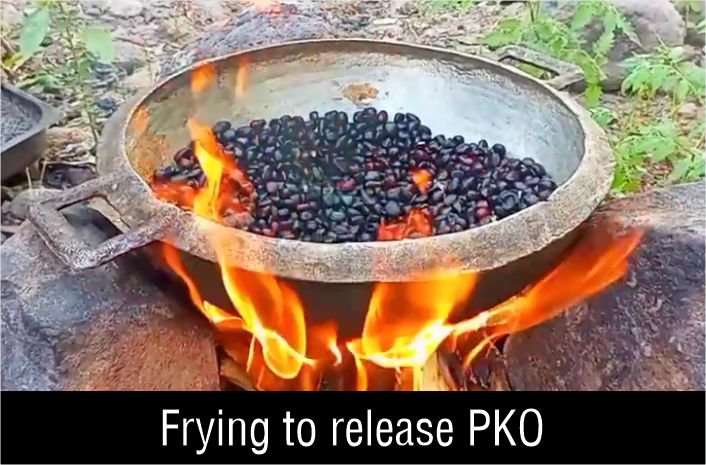
My grandmother made kernel oil in a garri pot, stirring roasted kernels over the fire until black oil seeped out. Palm kernel oil extraction has come a long way since then, from that village pot to steel factory presses. This page explains every method in turn, with tested yields for each one.
Palm kernel oil comes from the hard white kernel inside the oil palm’s nut, not from the orange fruit flesh.
Getting it out takes several steps, from drying and cracking the nuts to roasting, pressing or dissolving the oil.
This page walks through each step carefully, then compares four methods side by side.
They are home roasting, small screw presses, industrial crushing plants and solvent extraction.
It discusses the yields researchers have measured, what happens to the press cake and shells, and how to stay safe.
Where I describe my own family’s method in Ntigha, I say so plainly.
Kernel oil comes from the seed, but red oil comes from the fruit flesh around it. The shop page sells red oil pressed from the fruit, never from the kernel.
What Is Palm Kernel Oil Extraction?
Palm kernel oil extraction is the process of removing oil from the kernel, the seed inside the hard shell of the palm nut.
It begins after the fruit flesh has been processed for red or crude palm oil.
The nuts are dried and cracked, the kernels are separated from the shells, and the kernels are dried again.
Oil is then released by heat, by mechanical pressing or by chemical solvents, depending on the scale.
The result is crude palm kernel oil, plus a solid press cake and the cracked shells.
Palm Kernel Oil Extraction at a Glance
| Measure | Figure | Source |
|---|---|---|
| Oil content of the kernel, by laboratory extraction | 49.6 percent | 2006 Nigerian study |
| Best yield from a laboratory screw press | 47.0 percent | 2006 Nigerian study |
| Yield from a Nigerian small screw press | 33.6 percent | 2017 Nigerian study |
| Average extraction rate in Malaysian crushing plants | 45.63 percent | MPOB bulletin |
| Kernel moisture accepted by crushing plants | 7 percent maximum | MPOB bulletin |
| Village roasting yield in Ntigha | About 1 liter from a bucket of kernels | Family experience |
The figures differ because each method squeezes out a different share of the oil. The sections below explain where each number comes from, and what it measures.
Step 1: Dry the Nuts
After the fruit flesh is pounded or pressed for red oil, the nuts are left over. FAO’s guide to small-scale palm oil processing notes that small processors sun-dry these nuts for later cracking.
The guide adds that many small operators sell the dried nuts to others who make kernel oil.
Drying shrinks the kernel slightly away from the shell, which makes cracking easier.
In Ntigha, nuts were spread in the sun for months before cracking. My childhood memories of that work are told in kernel oil and ude aki types.
Step 2: Crack the Nuts
| Cracking method | How it works | Where it is used |
|---|---|---|
| By hand | Each nut is struck between two stones | Village homes, now less common |
| Village cracking machine | A small motor-driven cracker, moved from village to village | Rural Nigeria |
| Centrifugal cracker | Nuts are thrown at high speed against a hard ring | Palm oil mills |
The FAO guide notes that large mills crack dried nuts in centrifugal crackers to release the kernels. Hand cracking is slow, but it breaks fewer kernels than fast machines do.
Step 3: Separate the Kernels From the Shells
When we cracked nuts by hand in Ntigha, the kernel fell free as the shell split. We picked each kernel into a basket, and the shell pieces scattered on the ground around us.
Machine cracking mixes everything, so kernels and shells come out in one heap. We then had to pick the kernels out one after the other. This is very tedious and make the job boring.
Mills do this sorting job mechanically, at a much larger scale than homes. The FAO guide says kernels are normally separated from shells using winnowing and hydrocyclones, which sort pieces by weight.
Step 4: Dry and Store the Kernels
Kernels must be dry before extraction, or they spoil and give less oil. The FAO guide says mills dry kernels to about 7 percent moisture before packing.
The same guide warns that free fatty acids rise much faster in broken kernels than in whole ones. Careful cracking and dry storage therefore protect the quality of the final oil.
Selling Kernels in Abia
Families who crack more kernels than they need sell them at the two big markets near Ntigha.
These are Orie Ntigha and Orie Ukwu Amorji, where bulk buyers collect kernels from the villages.
Sellers there usually measure their kernels in small, reused plastic custard buckets. Those buyers then move the kernels on to crushers and factories elsewhere.
Method 1: Home Roasting, the Ude Aki Way
Ude aki is black palm kernel oil, made at home by roasting kernels until their oil runs out. My grandmother made it, and my mother and I still make it today.
- Put the dry kernels into a wide pot, such as the shallow pots used for frying garri.
- Set the pot over a wood fire and keep the heat steady.
- Stir from time to time as the kernels darken and begin to smoke.
- Keep roasting until the kernels turn black and dark oil seeps out from the heat.
- Take the pot off the fire and let it cool completely.
- Pour the dark oil into a clean bottle, leaving the burnt kernels behind.
The roasting takes roughly 45 minutes to an hour, depending on the heat. Nobody squeezes or presses the kernels, since the heat alone draws the oil out.
In my family’s experience, a bucket of kernels gives about one liter of ude aki. That is a small yield compared with a press, because much oil stays locked in the roasted kernels.
The oil comes out dark brown to black, with a strong roasted smell. Its uses and health questions are covered in black kernel oil and health.


Method 2: Small Screw Presses
Across Nigeria, small mills crush kernels in screw presses, also called expellers. A rotating screw forces ground kernels through a narrowing barrel, squeezing out oil while the solid cake exits the end.
A 2006 study by Akinoso and colleagues tested how moisture and heating affect screw press yield from Nigerian kernels.
Laboratory extraction showed that the kernels held 49.6 percent oil by weight.
The best press yield was 47.0 percent, at 4.5 percent kernel moisture and 5 minutes of heating at 130°C.
Yields fell steadily as kernel moisture rose, down to 9.3 percent at the wettest setting.
A 2017 study in the Nigerian Journal of Technology tested a locally used Magnus screw press. It gave an oil yield of 33.6 percent, with an expelling efficiency of 73 percent.
The press handled about 92 kilograms of product an hour, but its cake still held 13.6 percent oil.
That leftover oil is the main reason larger plants add solvent extraction.
| Setting | What the studies found |
|---|---|
| Kernel moisture | Lower moisture, around 4.5 to 5 percent, gave the best yields |
| Heating before pressing | Short heating at around 130°C improved yield |
| Wet kernels | Yields dropped sharply as moisture rose |
| Small press efficiency | About 73 percent of the oil was expelled in the 2017 test |
Method 3: Industrial Crushing Plants
Large kernel crushing plants run the same pressing idea at a much bigger scale, with careful preparation. An MPOB bulletin on kernel crushing plants by Yap and Halim sets out the steps.
- Clean. Magnets and vibrating screens remove metal, sand and stones from the kernels.
- Break. Hammer grinders or breaker rolls smash the kernels into pieces.
- Flake. Rollers press the pieces into flakes 0.25 to 0.4 mm thick.
- Condition. A steam-heated cooker brings the meal to about 104 to 110°C and about 3 percent moisture.
- Press. Screw presses squeeze the oil out of the hot, conditioned meal.
- Clarify. A decanter or vibrating screen, then a filter press, cleans the crude oil.
The bulletin reports an average extraction rate of 45.63 percent in Malaysian plants. In its worked example, 1,000 kilograms of kernels gave 456.3 kilograms of crude kernel oil and 543.7 kilograms of cake.
Plants accept kernels with at most 6 percent dirt and 7 percent moisture. The crude oil is sold with moisture and impurities of no more than 0.5 percent.
Method 4: Solvent Extraction
Solvent extraction recovers most of the oil still left in press cake. The cake is washed with a solvent, usually hexane, which dissolves the oil.
The solvent is then evaporated off the oil and recovered for reuse, and the cake is heated to drive out the last traces. The crude oil then travels on to a refinery for further cleaning.
The MPOB bulletin notes that solvent extraction is not encouraged for edible processes. Many kernel plants therefore rely on pressing alone, while others add solvent plants for the extra oil.
Hexane is highly flammable, and it can harm workers who breathe it. A US CDC report describes nerve damage, with numbness and weakness, in workers with long exposure to n-hexane.
The Four Methods Compared
| Method | Equipment | Yield | Oil produced | Scale |
|---|---|---|---|---|
| Home roasting | Pot and wood fire | Low, about 1 liter per bucket in my family | Black ude aki | One household |
| Small screw press | Electric expeller | About 33.6 percent in a 2017 Nigerian test | Light crude kernel oil | Village and small town mills |
| Crushing plant | Flakers, cookers, screw presses, filters | About 45.6 percent average in Malaysia | Crude kernel oil for refineries | Industrial |
| Solvent extraction | Hexane plant, added after pressing | Recovers most oil left in cake | Crude kernel oil for refineries | Large industrial |
After Extraction
Crude kernel oil is left to settle, then filtered to remove fine particles and water. Refineries go further, bleaching and deodorizing it into pale, odorless refined oil.
Some refined kernel oil is hardened for coatings and creamers, as covered in hardened kernel fats and their uses.
Kernel oil also feeds soaps, surfactants and other derivatives listed in the kernel’s industrial derivatives.
| By-product | What it is | Common use |
|---|---|---|
| Palm kernel cake | The solid left after pressing or solvent washing | Livestock and poultry feed |
| Kernel shells | Hard pieces left after cracking | Fuel for boilers and cooking, and filling muddy paths |
| Burnt kernels from roasting | Black residue left in the ude aki pot | Usually discarded |
Where the kernel sits inside the fruit, layer by layer, is shown in the kernel inside the fruit.
Safety During Extraction
| Step | Risk | How to stay safe |
|---|---|---|
| Hand cracking | Shell splinters in eyes and skin | Crack slowly and keep small children away |
| Machine cracking | Moving parts and flying shells | Let trained operators run the machine |
| Roasting ude aki | Burns, smoke and spitting oil | Use a stable pot, stir with a long spoon and work outdoors |
| Screw pressing | Hot oil and moving screws | Guard the machine and never reach inside |
| Solvent extraction | Fire, explosion and nerve damage from hexane | Leave it to licensed plants with proper ventilation |
Conclusion
Palm kernel oil extraction turns the hard kernel inside the palm nut into oil, through drying, cracking, separating and then roasting, pressing or dissolving.
In Ntigha, my family still roasts kernels for black ude aki, getting about a liter from a bucket.
Small Nigerian screw presses yielded about 34 percent oil in one test, while Malaysian crushing plants average almost 46 percent.
Dry kernels and careful heating make the biggest difference to the final yield.
Whatever method you use, keep kernels dry, handle heat carefully and leave solvents to licensed plants.
Frequently Asked Questions
How is palm kernel oil extracted?
Dried nuts are cracked, and kernels are separated from shells and dried again. Oil is then released by roasting, screw pressing or by washing the cake with solvent.
How much oil is in a palm kernel?
A 2006 Nigerian study measured 49.6 percent oil in palm kernels by laboratory extraction. Malaysian crushing plants recover roughly 45.6 percent of the total kernel weight as oil.
How is ude aki made?
Dry kernels are roasted in a pot for about an hour, until dark oil seeps out. Once the pot cools, the oil is poured off into clean bottles.
What is the best moisture for pressing palm kernels?
Studies of Nigerian kernels found the best screw press yields at 4.5 to 5 percent moisture. Wetter kernels gave much less oil, so drying them well really matters.

Chimeremeze Emeh is a tropical crop farmer and chemical engineer from Ntigha, Isiala Ngwa North LGA, Abia State, Eastern Nigeria, specializing in palm oil and cassava, with over 30 years of hands-on experience growing, harvesting, and processing red palm oil. He runs community engagement workshops for rural farmers in Ntigha focused on palm tree care, and operates Palm Oil Pathway as a registered agribusiness and sells red palm oil in 1L, 2L, 3L, and 25L packaging. Built around red palm oil production. He is also the founder of Cassava Pathway, a CAMA-registered agribusiness founded in 2024, where he applies the same tropical farming expertise to cassava flour and starch production.