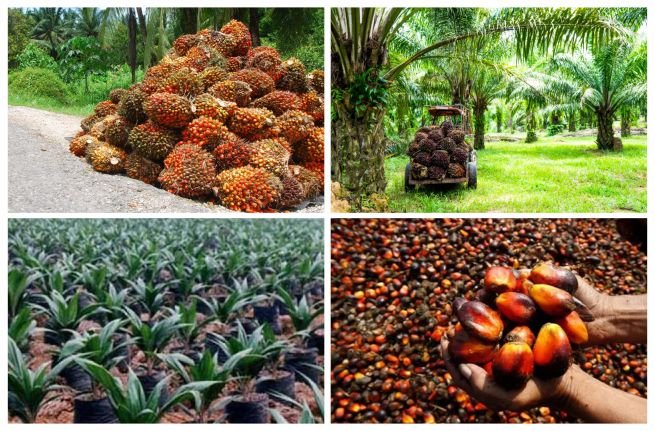
Some palms on my father’s plantation grew so tall that nobody could see their bunches from the ground. Oil palm cultivation, I learned there, is a long relationship with a tree that keeps bearing fruit for decades. Getting the early choices right, from seed to spacing, decides what that tree gives you for the rest of its life.
The oil palm is not a quick crop, and that slow start is exactly why careful planning pays off.
Seed choice, soil, spacing and nursery care all happen years before the first ripe bunch ever reaches a buyer. After that, the tree needs steady attention between harvests if it is to stay productive for decades.
Every stage, from germinating seed to cutting ripe bunches, has a dedicated guide on this site for deeper reading.
Start here for the full picture, then follow the link at each stage that matches where your farm stands today.
Want red oil made the village way, pressed and decanted on my family farm and never stored? You can order fresh red oil from Abia through the shop page.
Table of Contents
What Is Oil Palm Cultivation?
Oil palm cultivation is the growing of the oil palm tree, Elaeis guineensis, for the fruit bunches that yield palm oil and palm kernel oil.
It covers the whole life of the crop, from choosing seed and raising seedlings to planting, feeding and protecting palms in the field.
It continues through years of pruning and weeding, then ends each cycle with cutting ripe bunches and getting them to a mill.
Farms range from a few palms around a family compound to plantations covering thousands of hectares.
Oil Palm Cultivation at a Glance
| Stage | Typical timing | Main tasks |
|---|---|---|
| Seed and germination | Before nursery | Buy certified tenera seed or sprouted nuts |
| Nursery | Several months in bags | Water, feed and cull weak seedlings |
| Field planting | Start of the rainy season | Plant at about 143 palms per hectare |
| Young palms | First three years | Weed, feed, protect, grow food crops between rows |
| First bearing | About year three | Start light harvest rounds |
| Commercial harvest | From years five to six | Harvest every round, prune, weed and feed |
| Productive life | About 25 to 30 years | Keep palms reachable until they grow too tall |
Why Oil Palm Suits West Africa
The oil palm is an African tree, and the warm, wet belt of West Africa gives it much of what it needs.
Farmers there have grown and harvested it for generations, long before plantations spread across Southeast Asia.
An FAO publication on the African oil palm lists at least 1,600 millimeters of well-distributed rainfall as a minimum. It adds relative humidity of at least 75 percent and about 2,000 hours of sunlight a year.
Those numbers explain why the tree thrives in humid lowlands and struggles where long dry seasons bite hard.
Before you plant, check your local rainfall pattern against the climate oil palms need, since a short dry spell affects yield more than many new growers expect.
Where the dry season runs long, some growers water young palms or mulch heavily to carry them through. The guide to watering palms through dry spells explains when extra water pays off.
The detailed breakdown of the climate oil palms need covers rainfall, temperature and sunshine in more depth.
Choosing Your Planting Material
The seed you plant decides the yield ceiling of your farm for the next two or three decades.
No amount of fertilizer or care later can fully make up for poor planting material at the start.
Oil palms come in three main fruit forms, called dura, tenera and pisifera, and each carries a different shell thickness.
Dura fruit has a thick shell and less oil, while tenera, a cross between dura and pisifera, has a thin shell and more oil.
| Fruit form | Shell | Oil content | Main role |
|---|---|---|---|
| Dura | Thick | Lower | Common in wild groves, mother palm for breeding |
| Tenera | Thin | Higher | The form most farmers plant today |
| Pisifera | None | Many bunches fail | Pollen parent for producing tenera seed |
Tenera is the form most commercial growers plant today, and in Nigeria the National Oil Palm Research Institute breeds improved tenera material.
Buy sprouted seeds or seedlings from a trusted source, because counterfeit seed can cost you years of lost yield.
Pisifera palms rarely appear in farmers’ fields, because many of their bunches fail to develop and they serve mainly as breeding parents.
Seed producers cross dura mother palms with pisifera pollen to produce the tenera seed that farmers buy.
Each fruit holds an oily outer pulp, a hard shell and a kernel, and the balance between them decides your oil.
A closer look at how a palm fruit is built shows each layer and why tenera gives more oil.
You can compare dura, tenera and pisifera palms side by side before you buy anything.
Site and Soil
Oil palms grow best in deep, well-drained soil that holds moisture without staying waterlogged after heavy rain.
The same FAO publication lists a soil depth of about 100 centimeters as a basic requirement for the tree.

Avoid low spots where water stands for days, since roots suffer quickly in soil that cannot breathe.
Gentle slopes can work well, provided you manage erosion and plant along the contour rather than straight downhill.
Distance to the nearest mill or buyer matters as well, because fresh fruit loses quality quickly once it is cut.
A farm far from any processor needs its own small processing setup or reliable transport arranged in advance.
A soil test before planting tells you what nutrients are missing and how acidic the ground is.
The guide to soil conditions for healthy palms explains what to test for and how to read the results.
Starting a Farm
A palm farm starts on paper long before anyone clears a single bush or plants a single seedling.
You need a budget, a source of planting material, labor for the first years, and a plan for selling your fruit.
Think honestly about the wait before income, because a young palm needs several years to reach a useful harvest.
Many smallholders grow food crops between young palms in the early years to cover costs while the trees mature.
Keep simple records from the first day, including planting dates, fertilizer use, costs and every harvest.
Those records show you which blocks perform well and where money is slipping away.
The step-by-step guide to planning a new palm farm covers budgeting, land and layout.
Once the plan is ready, clearing and preparing your land comes next.
Mistakes That Cost New Growers Years
The costliest mistakes happen before the first seedling goes into the ground, and they are hard to undo later.
Cheap seed of unknown origin, crowded planting and a skipped soil test can each cost a grower years of yield.
Another mistake comes later, when growers treat bearing palms as self caring and stop looking after them.
The rundown of problems growers run into covers each mistake and how to avoid it.
The Nursery Stage
My father never ran a nursery, because young palms sprouted on their own all over his farms. He simply uprooted them and moved each one to a place where it had room to thrive.
That old way costs nothing, but seedlings that sprout from fallen fruit do not breed true, so their oil yield is a gamble.
Most commercial oil palm farms therefore begin in a nursery, where chosen seeds sprout and grow into strong seedlings before field planting.
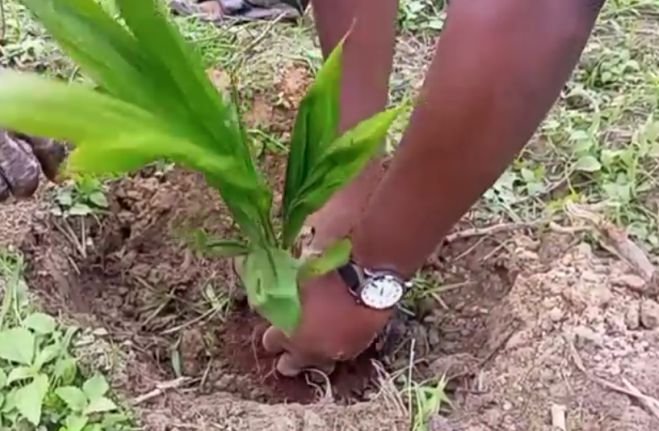
Good nursery care gives each young palm a healthy start and lets you weed out weak plants early.
Seeds first need to germinate, which takes patience and the right conditions for the hard nut to crack and sprout. If you raise your own, the guide to germinating oil palm seeds explains the process from dry seed to sprout.
Sprouted seeds then grow in bags, first in a small pre nursery and later in a larger main nursery. When it is time to plant out, an FAO farmer manual on the oil palm advises choosing the biggest and best grown seedlings.
You can follow every step of running a seedling nursery, from filling polybags to culling weak plants.
Planting and Early Care
Timing matters at planting, and the FAO manual recommends planting at the start of the rainy season.
That gives young palms time to build roots before the dry season arrives and stresses them.
The guide to choosing your planting season covers local timing in more detail.
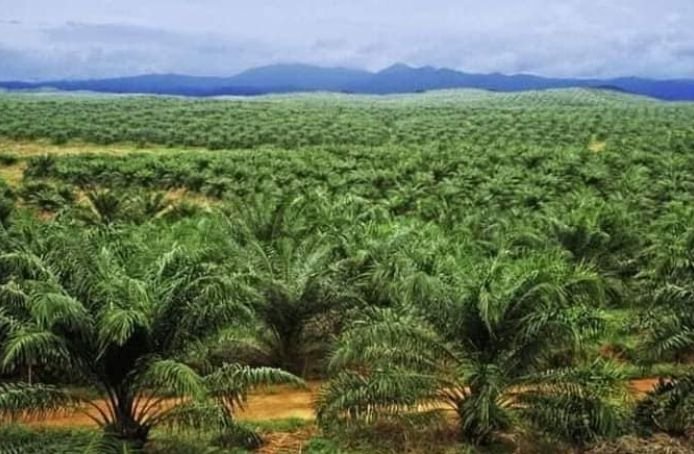
Spacing matters just as much, because palms planted too close compete for light while palms planted too far apart waste land.
The same manual recommends 143 palms per hectare, set in a triangle with rows 7.8 meters apart and palms 9 meters apart.
A full plan for laying out a plantation shows how to mark out rows and blocks before planting.
Young palms need regular feeding, careful weeding around the base, and protection from rodents and grazing animals.
A sound plan for feeding palms with fertilizer keeps them growing steadily through these early years.
Caring for Palms Between Harvests
Many palm tree owners in my community visit their palms only to check for ripe bunches and cut them.
Between harvests, the trees get very little care, and that habit quietly lowers yields over the years.
This is my own observation from my community rather than a finding from a formal study. Still, the pattern is easy to see once you know what a well kept palm looks like.
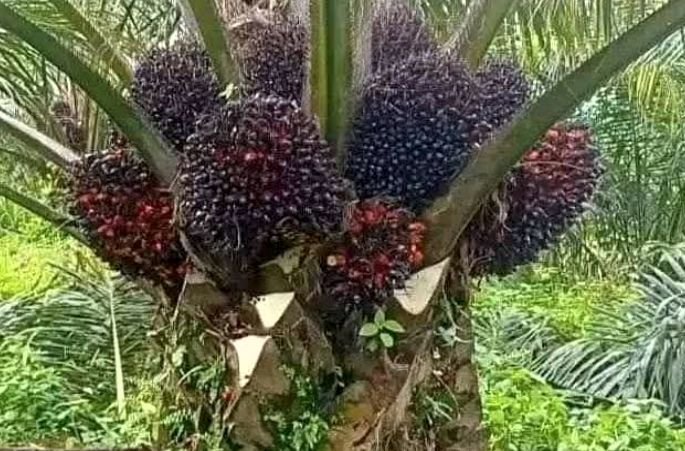
A cared for palm gets dead fronds pruned, a clean weeded circle around its base, and regular checks for pests.
Pruning also helps at harvest time, since old fronds can block access to ripe bunches and hide them from view.
The guide to looking after a mature palm sets out a simple routine you can follow between harvests.
If you are unsure which fronds to remove, see what palm fronds do for the tree.
Pests and diseases deserve special attention, because a single problem can spread quietly through a whole farm.
Learn the signs of common pests and diseases so you can act before damage shows in your harvest.
Harvesting
Harvest is where the years of work finally pay back, provided you cut each bunch at the right moment.
On my father’s plantation, the foot of the tree told us when a bunch above had ripened.
Each harvest unit is a fresh fruit bunch, a tight cluster of fruits packed around a thick central stalk.
The guide to the fresh fruit bunch itself helps you judge quality at the farm gate.

Fresh loose fruit on the ground, empty sockets on the bunch, and reddish orange flesh all signal a ripe bunch.
Regular harvest rounds keep ripe bunches from sitting too long on the palm and dropping fruit.
Gather every loose fruit on each round, because fallen fruit carries oil you have already paid to grow.
The full method for reading bunch ripeness from the ground explains each sign in turn.
Cutting itself needs care, especially as palms grow taller and bunches sit high above the ground.
Hands-on advice on cutting bunches safely covers tools, timing and handling fruit after it falls.
For a closer look at each cutting tool, see the tools for cutting bunches before the season starts.
What Yield to Expect
Growers measure yield in tons of fresh fruit bunches harvested from each hectare in a year.
Yields climb as young palms mature, then level off before falling as the palms grow old and tall.
A 2023 study in Agricultural Systems measured 977 independent smallholder fields in Indonesia over two years. Average yield was 13.9 tons of bunches per hectare, only 42 percent of the 33.4 tons those fields could attain.
The authors linked much of that gap to fertilizer use, harvest intervals, weed control and pruning, all everyday management choices. That finding echoes the harvest-only habit I described earlier, though their fields were in Indonesia rather than Nigeria.
Recent, reliable yield figures for Nigerian smallholders are harder to find, so treat the Indonesian numbers as a guide rather than a promise.
What the study does show is that care between harvests can more than double what a farm produces.
A Changing Climate
Oil palms depend on steady rain and warmth, so shifts in weather patterns matter directly to every grower.
Longer dry spells, heavier storms and rising temperatures can all stress palms and reduce bunch production.
Research on this question has so far centered mostly on Southeast Asia, where most palm oil is grown today.
West African growers can still learn from it, since the tree responds to heat and drought the same way everywhere.
Simple steps such as mulching, keeping soil covered and planting at the right time all help palms cope better.
You can read more about how climate change affects growers and what smallholders can do to prepare.
What Research Shows About Growing Oil Palm
Published research supports several of the rules that experienced growers follow, and it adds useful numbers to them.
Three findings in particular stand out for anyone planning a new palm farm today.
A 2018 study in the journal OCL tested planting distances from 7.5 to 9.5 meters on a plantation near Benin City in Nigeria.
After twelve years, the authors estimated the best density at 143 to 160 palms per hectare, with palms 8.5 to 9 meters apart.
The FAO publication on the African oil palm notes that new plantations start to bear at about three years.
It adds that the first commercial crop usually takes five to six years, and that palms produce for 25 to 30 years.
The same source says production continues until the palms grow too high to be harvested, which matches what tall palms taught my family.
Height, not age alone, eventually ends the useful life of many palms.
A 2015 study in Scientific Reports modeled future climate effects on oil palm in Malaysia and Indonesia. It found that climate suitability would decline gradually by 2030 and more sharply by 2100.
These findings have limits worth stating plainly before you plan around them.
The spacing trial covered one Nigerian plantation, and its authors said more years of data were still needed.
The climate study, meanwhile, modeled Southeast Asia rather than West Africa, so local effects may differ.
Conclusion
The tall palms on my father’s plantation were a reminder that this crop rewards patience and long term care.
Choose good tenera seed, plant at the right spacing, and give young palms a strong start in the nursery.
Then keep caring for the trees between harvests, not only on the day you cut bunches.
Small, steady habits repeated every season matter more than any single big decision on the farm.
Once your fruit is ready, see what happens at the mill after harvest, or return to the full palm oil guide for the bigger picture.
Frequently Asked Questions
How long does an oil palm take to produce fruit?
New palms start bearing at about three years, according to FAO guidance on the crop. The first commercial crop, however, usually takes five to six years to arrive.
How many oil palms should I plant per hectare?
A twelve year Nigerian trial found 143 to 160 palms per hectare worked best. FAO guidance also recommends 143 palms per hectare, set out in a triangular layout.
What climate does the oil palm need?
Oil palms need warmth, high humidity and at least 1,600 millimeters of rain each year. Long dry seasons reduce yields, so check your local rainfall record before planting.
How long does an oil palm keep producing?
An oil palm keeps producing for about 25 to 30 years, according to FAO. Production usually ends when palms grow too tall to harvest, not from age alone.