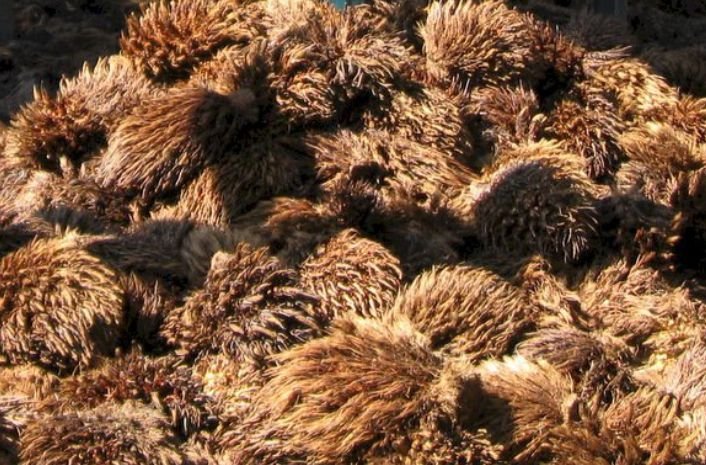
An empty fruit bunch is the woody, spiky stalk left after all the fruit has been stripped from an oil palm bunch. It is rich in potassium and fiber, so mills return it to fields as mulch or compost. Villages burn it for fuel and use its ash for soap and potash.
In Ntigha, nothing from the harvested palm bunch goes to waste, least of all the empty stalk.
Once the fruit is picked off for oil, the bare stalk dries and fuels the kitchen fire, and its ash once gave families lye for homemade soap.
Ash from burned stalks also gives potash, used to make ngo, the bright orange sauce we stir from red palm oil.
To understand what empty fruit bunch is, and what nutrients it contains, its uses in villages and on plantations, from mulch and compost to fuel, potash, and new industrial products, we have carefully researched this topic, and here is everything.
We also discuss the stalk left after the fruit is removed. The whole bunch, from flower to harvest, is described in the fresh fruit bunch.
Table of Contents
What Is an Empty Fruit Bunch?
An empty fruit bunch, commonly shortened to EFB in the trade, is the stalk and spikelets left after fruit is stripped from a harvested palm bunch.
Mills strip fruit mechanically after steaming the bunches, while village processors pick fruit off by hand.
The empty bunch is fibrous, spiky and wet when fresh, but it dries hard in the sun. It holds no oil worth extracting, yet it carries nutrients the palm took from the soil.
That makes it one of the most useful by-products in the palm chain. Its place among the mill’s outputs is set out in palm milling and its by-products.
What Does an Empty Fruit Bunch Contain?
Empty bunches are mostly fiber and water, with a valuable load of mineral nutrients. A 2004 study in the Journal of Oil Palm Research by Saletes and colleagues named potassium as the main nutrient in empty bunches.
The same study found that nutrients leak out quickly when bunches are stored in heaps. After two weeks, about 73 percent of the potassium had left bunches at the top of a heap.
Magnesium and boron also washed out, at 48 and 60 percent from the upper heap. The released nutrients simply collected in the bunches lying at the bottom of the heap.
That finding matters for anyone planning to use empty bunches as fertilizer on their palms. Spread them on fields soon after milling, rather than leaving them in exposed heaps for weeks.
Traditional Uses of Empty Bunches in Igbo Land
| Use | How it is done | What it gives |
|---|---|---|
| Kitchen fuel | Dried stalks are burned in open fires | Heat for cooking and boiling fruit |
| Soap ash | Stalks are burned and the ash soaked in water | Lye for traditional homemade soap |
| Potash for ngo | Ash from burned stalks is used to make potash water | The alkali that turns red oil into ngo |
| Soil cover | Stalks are left to rot under palms and crops | Organic matter returned to the soil |
Fuel for the Fire
Dried empty bunches burn hot and long, so families use them to boil palm fruit and cook food. They save firewood and clear the processing area at the same time.
Ash for Soap
Before shop soap reached every village, many families burned bunch stalks and soaked the ash for its lye. That lye was then cooked with oil to make soft, dark soap at home.
I never learned the full recipe, but some households may still make this soap quietly. Modern palm soap recipes, along with that tradition, are covered in bunch-ash soap and palm soaps.
Potash for Ngo
Ash from burned stalks also gives potash, the alkali used to make ngo. Cooks stir potash water into red palm oil until it thickens and turns bright orange.
Ngo is then served with ugba, the fermented oil bean salad, and other dishes. How ngo is made from red oil is described in ngo and other red oil dishes.
Empty Bunches as Mulch on Plantations
Large plantations return empty bunches to the field as mulch, spreading them between palms. The mulch protects the soil, holds moisture and slowly releases its nutrients as it rots.
A 2002 study by Lim and Zaharah in the Journal of Oil Palm Research tested empty bunch mulch on 17-year-old palms. In that trial, bunches were spread in a 2-meter band between the palm rows.
The best result came from 37.5 tonnes of empty bunches per hectare a year, combined with nitrogen and potassium fertilizer. That treatment raised bunch numbers, average bunch weight and total fruit yield per hectare.
The study also found higher exchangeable potassium, calcium and magnesium in the soil, and better soil pH. Results came from a single site, so local trials are still wise.
- Spread in a single layer. Lay bunches one layer deep, not in thick piles.
- Keep away from the trunk. Leave space around the palm base for weeding and fertilizer.
- Apply soon after milling. Fresh bunches lose nutrients fast if left in heaps.
- Combine with fertilizer. Empty bunches work best alongside mineral nitrogen and potassium.
Mineral fertilizer programs to pair with mulch are covered in palm fertilizer rates and timing.
Composting Empty Bunches
Composting speeds up the breakdown of empty bunches and makes them easier to spread. Mills shred the bunches, mix them with other waste and turn the heaps regularly.
Many mills mix shredded bunches with treated mill effluent, which adds moisture and nutrients. The finished compost is darker, finer and quicker to release nutrients than fresh bunches.
How mill effluent is treated before use is set out in palm mill wastewater treatment.
Pruned fronds can be composted with empty bunches too, adding bulk and extra nutrients. Their role on the farm is covered in palm fronds and their uses.
Empty Bunch Ash as Potassium Fertilizer
Burning empty bunches leaves an ash rich in potassium, the nutrient fruiting palms need most. Researchers are now turning this ash into ready-made fertilizer that farmers can spread easily.
A 2025 study in Jurnal Teknologi by Erizal and colleagues made granular potassium fertilizer from empty bunch incineration ash. Its best granules contained 36.72 percent potassium, according to the analysis reported by the authors.
Village potash and plantation ash fertilizer come from the same simple chemistry. Burning the bunch removes the fiber and concentrates its minerals into the ash left behind.
Empty Bunches as Fuel and New Products
Beyond the farm, empty bunches can also become energy, fiber and other useful materials.
- Boiler fuel. Dried and shredded bunches can be burned in mill boilers, though they are wetter than shells.
- Biogas and bioethanol. Researchers are testing empty bunch fiber for gas and fuel production.
- Fiber products. Bunch fiber can be made into mattresses, mats, panels and paper.
- Growing medium. Shredded bunches serve as a base for growing mushrooms.
Palm residues used for energy, including empty bunches, are covered in palm biofuels and biomass. Kernel shells, a denser fuel, are described in kernel shells as boiler fuel.
Problems With Empty Bunches
Empty bunches bring a few risks when they are stored, spread or burned badly.
- Beetle breeding. Rhinoceros beetles breed in rotting bunch heaps, as covered in beetles in bunch heaps.
- Nutrient loss. Bunches left in open heaps lose most of their potassium to rain.
- Smoke and pollution. Open burning releases smoke and wastes nutrients that could feed the soil.
- Transport cost. Bunches are heavy and bulky, so spreading them far from the mill costs money.
The Smallholder Oil Palm Handbook’s beetle guide advises turning over and pulling apart bunch piles to speed decomposition. That step also exposes beetle larvae in the heap, so they can be killed.
Conclusion
An empty fruit bunch is the stalk left after palm fruit is stripped, and it is rich in potassium and fiber.
In Ngwa, dried stalks fuel the kitchen fire, and their ash once made soap and still makes potash for ngo.
On plantations, empty bunches return to the field as mulch or compost, raising yields when combined with fertilizer.
Spread fresh bunches quickly, because stored heaps lose most of their potassium. Next time you strip a bunch, keep the empty stalk and put it back to work on your farm.
Frequently Asked Questions
What is an empty fruit bunch?
An empty fruit bunch is the woody, spiky stalk left after palm fruit is stripped. It is rich in potassium and fiber, so it makes mulch and fuel.
What are empty fruit bunches used for?
Empty fruit bunches are used as mulch, compost, boiler fuel and potassium-rich ash for fertilizer. In Igbo homes, burned stalks give lye for soap and potash for ngo.
How much empty fruit bunch should be applied per hectare?
One Malaysian study found 37.5 tonnes per hectare yearly worked best alongside nitrogen and potassium fertilizer. Rates on your farm depend on soil, palm age and local conditions.
Is empty fruit bunch ash a good fertilizer?
Yes, empty fruit bunch ash is rich in potassium, the nutrient fruiting palms need most. A 2025 study turned the ash into fertilizer granules containing 36.72 percent potassium.

Chimeremeze Emeh is a tropical crop farmer and chemical engineer from Ntigha, Isiala Ngwa North LGA, Abia State, Eastern Nigeria, specializing in palm oil and cassava, with over 30 years of hands-on experience growing, harvesting, and processing red palm oil. He runs community engagement workshops for rural farmers in Ntigha focused on palm tree care, and operates Palm Oil Pathway as a registered agribusiness and sells red palm oil in 1L, 2L, 3L, and 25L packaging. Built around red palm oil production. He is also the founder of Cassava Pathway, a CAMA-registered agribusiness founded in 2024, where he applies the same tropical farming expertise to cassava flour and starch production.