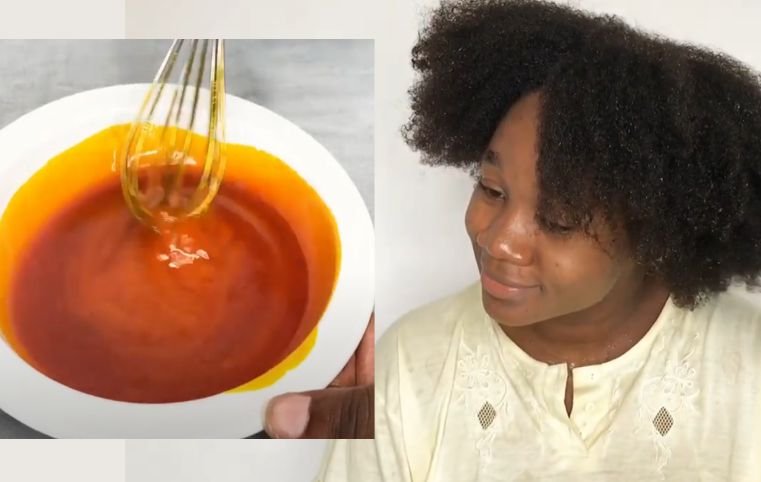
In my hometown, red palm oil does not have any business with hair, and rubbing it into hair sounds very strange to my family. Yet red palm oil for hair now fills seller blogs and videos. This page checks those promises, one by one, against what researchers have actually tested.
Red palm oil is sold online as a hair oil that grows hair, stops shedding, prevents gray hair and guards against sun and chlorine.
Its deep orange color comes from carotenoids, and it also carries vitamin E compounds called tocotrienols.
Those nutrients are real, but no published trial anywhere has yet tested red palm oil itself on human hair or scalp.
This page covers what the oil contains, what research on other oils and on tocotrienol capsules has found, and how people apply it.
Learn more about staining, scalp patch tests and the signs that hair loss needs a doctor.
Anyone trying red oil on hair or in the kitchen needs oil that is clean and undyed. The shop page sells unblended red oil from wild palms pressed on one farm in Abia State.
Table of Contents
What Does Using Red Palm Oil on Hair Mean?
Using red palm oil on hair means working the orange oil pressed from palm fruit flesh into the scalp, strands or ends.
Some people leave it on for an hour before washing, while others mix it into homemade hair butters and leave-in blends.
This is a grooming habit, not a medical treatment, and no health authority approves it for hair loss.
It also differs from palm kernel oil, which comes from the seed inside the nut and is pale when refined.
In my family and wider community, nobody puts red oil on hair, so everything here rests on published research rather than family habit.
What Is in Red Palm Oil
Red palm oil holds carotenoids, vitamin E and a fat mix of roughly half saturated and half unsaturated fatty acids.
A 2003 review of palm oil composition put carotenoids at about 500 to 800 ppm in crude palm oil.
The same review put vitamin E at about 500 to 1,000 ppm, mostly as tocotrienols. Sellers link these nutrients to hair claims, but the table below shows how little has been tested.
| Component | What sellers claim for hair | Tested on hair as red oil? |
|---|---|---|
| Beta-carotene and other carotenoids | Growth and shine | No |
| Tocotrienols, a form of vitamin E | Growth and less shedding | Only as swallowed capsules |
| Palmitic and oleic acids | Moisture and softness | No |
| Plant sterols | Scalp health | No |
What these nutrients do in the diet is set out in the nutrient profile of palm oil, with its research limits.
What Research Shows About Oils and Hair Damage
The best-known study of oils on hair tested coconut, sunflower and mineral oil, not red palm oil. Its findings still help explain why one hair oil cannot stand in for another.
A 2003 study in the Journal of Cosmetic Science by Rele and Mohile measured protein loss from hair treated with each oil.
Coconut oil was the only oil that clearly reduced protein loss, on both damaged and undamaged hair.
The authors linked that result to lauric acid, which bonds well with hair protein and can enter the hair shaft. Sunflower oil and mineral oil showed no such benefit in the same tests.
Red palm oil holds very little lauric acid, since its main fats are palmitic and oleic acids. The coconut result therefore cannot be carried over to red palm oil without a study of its own.
Palm kernel oil, by contrast, is rich in lauric acid, much like coconut oil. It has not been tested on hair in the same way, as noted in the palm kernel oil hub.
The Tocotrienol Capsule Trial
Most growth claims for red palm oil trace back to one Malaysian trial of tocotrienol supplements. That trial tested capsules swallowed by mouth, not oil rubbed into the scalp.
The 2010 trial in Tropical Life Sciences Research enrolled 38 adults with hair loss at Universiti Sains Malaysia.
Twenty-one took tocotrienol capsules twice a day, and the other seventeen took a placebo for eight months.
The tocotrienol group gained about 34.5 percent more hairs in a marked scalp area than at the start, while many placebo takers lost hair. Hair weight, a second measure, did not differ between the two groups at the end.
| Feature of the trial | Detail |
|---|---|
| Product | Capsules of a palm tocotrienol complex, 100 mg a day |
| Route | Swallowed, not applied to hair |
| People | 38 volunteers, with a few dropping out |
| Length | Eight months |
| Supplier | The capsules came from Carotech, a palm tocotrienol maker |
The trial was small, used a concentrated supplement and has not been widely repeated. A spoonful of red oil on the scalp delivers nothing like that dose, and the scalp is not the gut.
How People Use Red Palm Oil on Hair
Online guides and natural hair groups describe several ways of applying red oil. These are reported practices, listed here without any promise that they work.
| Practice | How people describe it |
|---|---|
| Prewash treatment | Coat dry hair, cover it for an hour, then shampoo well |
| Scalp rub | Massage a few drops into the scalp with the fingertips |
| Oil blend | Mix red oil with coconut, castor or olive oil to thin it |
| Hair butter | Whip melted red oil with shea butter for the ends |
| Hot oil treatment | Warm the oil gently and test the heat on the wrist first |
Warmed oil can burn the scalp if it is too hot, so it should feel only slightly warm. Skin uses of the same oil appear in red oil as a body oil.
Staining on Light, Gray and Colored Hair
Red palm oil stains, and that matters more on hair than almost anywhere else. Its carotenoids can leave an orange or brassy tint on blonde, gray, white or bleached hair.
The tint may need several washes to fade, and it can mark pillowcases, collars and towels along the way. Darker hair hides the color better, though the oil still marks fabric.
| Hair or item | What red oil can do | A sensible step |
|---|---|---|
| Blonde, gray or bleached hair | Leave an orange or yellow cast | Test on a hidden strand first |
| Freshly colored hair | Change the shade slightly | Wait and ask the colorist |
| Dark hair | Little visible change | Still protect fabric |
| Pillowcases and towels | Orange marks that resist washing | Use old covers |
Refined palm oil is pale and does not stain, because refining strips the carotenoids. How the two oils differ is set out in red oil beside refined palm oil.
Patch Test the Scalp First
Any new oil can irritate a sensitive scalp, and homemade blends carry the same risk as bought products. Advice from the American Academy of Dermatology, reported by US Pharmacist, sets out a simple test.
The academy suggests applying a small amount to the inner arm twice daily for a week to ten days. Redness, itching or swelling during that time means the product should not go near the scalp.
When Hair Loss Needs a Doctor
Hair loss has many causes, from hormones and thyroid problems to iron deficiency, stress, tight braids and scalp infection. No oil can fix those causes, and some need prompt medical treatment.
| Sign | Why to see a doctor or dermatologist |
|---|---|
| Sudden shedding or bald patches | Can point to medical causes that need testing |
| Itching, scaling or sores on the scalp | May be a fungal infection or skin disease |
| Hair loss with tiredness or weight change | Can reflect thyroid or blood problems |
| Hair loss in a child | Needs a proper diagnosis before any home remedy |
Relying on red oil while a scalp infection spreads can delay treatment that actually works. A doctor or dermatologist can find the cause and suggest proven options.
Dyed Oil Has No Place on the Scalp
Some market red oil contains Sudan dyes, industrial colorants added to make pale or old oil look brighter. Germany’s risk assessment institute, the BfR, states these dyes are not permitted in food in the EU.
Oil tinted with industrial dye belongs nowhere near the scalp or the kitchen. Smell, color and laboratory tests for spotting it are listed in home and lab checks for dye.
Red Palm Oil Beside Other Hair Oils
The table compares look, feel and staining only, because no head-to-head trials exist for hair. It is not a ranking of which oil grows hair best or fastest for anyone.
| Oil | Color on hair | Feel | Research on hair |
|---|---|---|---|
| Red palm oil | Orange, can tint light hair | Soft paste in cool weather | No trials found |
| Coconut oil | Colorless | Solid below about 24°C | Reduced protein loss in a 2003 study |
| Shea butter | Ivory | Thick and waxy | Little direct research |
| Olive oil | Pale green to gold | Liquid and heavy | Little direct research |
| Palm kernel oil, refined | Pale | Firm when cool | No trials found |
Palm-derived ingredients in shop shampoos and conditioners are decoded in palm names on hair product labels.
Claims and What the Evidence Shows
| Claim | What the evidence shows |
|---|---|
| It makes hair grow faster | Not tested for red oil, and the capsule trial was oral |
| It stops hair loss | Not shown, and hair loss needs a diagnosis |
| It prevents gray hair | No evidence found |
| It protects hair from the sun | Not shown for red oil on hair |
| It shields hair from chlorine and salt water | No evidence found |
| It balances scalp oil | No evidence found |
| It reduces protein loss like coconut oil | Not tested, and its fats differ from coconut oil |
| It contains carotenoids and vitamin E | Supported by composition studies |
Conclusion
Red palm oil carries real carotenoids and tocotrienols, yet nobody has tested it as a hair treatment in a published trial.
The growth claims lean on a small study of swallowed capsules, and the protein claims borrow results from coconut oil. I
n my family the oil stays in the kitchen, and hair oiling with it feels strange to us.
If you still try it, use pure, undyed oil, patch test first and protect light hair from staining. For hair loss or scalp problems, book a visit with a doctor or dermatologist.
Frequently Asked Questions
Does red palm oil make hair grow?
No published trial has tested red palm oil rubbed into hair for growth. One small Malaysian trial found more hairs after swallowing tocotrienol capsules, which is very different.
Will red palm oil stain my hair?
Red palm oil can leave an orange, brassy tint on blonde, gray, white or bleached hair. Test a hidden strand first, and protect pillowcases and towels from marks.
Is red palm oil better than coconut oil for hair?
No study has yet compared the two oils directly on human hair. Coconut oil reduced protein loss in 2003 tests, linked to lauric acid, which red oil lacks.
Can red palm oil stop hair loss?
No published research shows red palm oil stops or slows hair loss. Shedding has many causes, including thyroid problems, iron deficiency and scalp infections, so see a doctor.
Sources for this article were last reviewed by the author in October 2026.
Disclaimer. This article is for informational purposes only and does not constitute medical, hair care or skincare advice. The author is not a dermatologist, trichologist or medical professional of any kind. Where research on cosmetic effects is limited, this is stated clearly in the article. Consult a qualified doctor or dermatologist before using red palm oil or any home remedy for hair loss or a scalp condition.

Chimeremeze Emeh is a tropical crop farmer and chemical engineer from Ntigha, Isiala Ngwa North LGA, Abia State, Eastern Nigeria, specializing in palm oil and cassava, with over 30 years of hands-on experience growing, harvesting, and processing red palm oil. He runs community engagement workshops for rural farmers in Ntigha focused on palm tree care, and operates Palm Oil Pathway as a registered agribusiness and sells red palm oil in 1L, 2L, 3L, and 25L packaging. Built around red palm oil production. He is also the founder of Cassava Pathway, a CAMA-registered agribusiness founded in 2024, where he applies the same tropical farming expertise to cassava flour and starch production.