One decision separates a profitable palm oil farm from a struggling one. That decision is planting Tenera. Every serious commercial grower on earth has already made it.
The Tenera oil palm tree is not one of several good options for commercial farming. It is the option. Across Nigeria, Malaysia, Indonesia,
Colombia and every other significant palm oil-producing country, Tenera accounts for the overwhelming majority of planted hectares.
That dominance did not happen by accident. It happened because Tenera solved a specific problem: how to get the highest possible oil yield from each hectare of tropical farmland, and it solved it better than any naturally occurring variety could.
This post covers what Tenera is, why it outperforms its parent varieties, how it is produced through controlled breeding, and what farmers need to know before planting it.
The Tree I Chose When I Decided to Farm Seriously
The palm trees I grew up to harvest and tend in my father’s inherited plots were Dura.
They seeded themselves across the land and produced oil for generations without anyone selecting them for yield.
That oil sustained families, including mine.
But when I decided to move beyond harvesting inherited trees and invest in deliberate commercial cultivation, the choice of variety was not a difficult one.
Tenera was the only rational option.
The yield difference between a well-managed Tenera plantation and an unimproved Dura grove is not marginal; it is the difference between farming as a livelihood and farming as subsistence.
Every goal-oriented palm oil farmer in South Eastern Nigeria who has made that transition understands exactly what I mean, because it was a gold rush in the 90s, even though it was established in 1957.
Table of Contents
What Is the Tenera Oil Palm Tree?
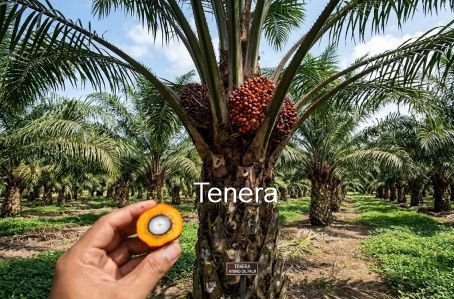
The Tenera oil palm, classified as Elaeis guineensis var. tenera, is a hybrid produced by crossing Dura and Pisifera parent palms under controlled conditions.
It is not a naturally occurring variety; every Tenera palm in existence was deliberately produced through a breeding program.
The name comes from the Latin word for tender or thin, referring to the characteristic thin shell that distinguishes Tenera fruit from the thick-shelled Dura and shell-less Pisifera.
That thin shell, combined with a thick oil-rich mesocarp, gives Tenera its exceptional oil extraction efficiency and makes it the commercial standard for palm oil production worldwide.
What Makes Tenera Fruit Different
The story of Tenera’s commercial dominance begins with its fruit structure.
Understanding the fruit is the key to understanding why this variety outperforms everything else.
Shell Thickness
Tenera fruit has a thin endocarp shell, typically between 0.5 and 4 millimeters thick.
This sits between Dura’s thick shell of 2 to 8 millimeters and Pisifera’s complete absence of shell.
The thin shell is not just a cosmetic difference; it directly determines how much of the fruit’s weight is oil-bearing mesocarp versus inert shell material.
Mesocarp Content
Because the shell is thin, the mesocarp, the fleshy outer layer where palm oil is stored, makes up a much larger proportion of the total fruit weight in Tenera than in Dura.
More mesocarp means more oil per fruit, more oil per bunch, and more oil per hectare.
This is the fundamental arithmetic behind Tenera’s yield advantage.
Oil Extraction Rate
Tenera palms regularly achieve oil extraction rates above 25 percent by fresh fruit weight and can reach significantly higher with optimal management.
Dura palms typically yield between 15 and 24 percent.
That gap, which sounds like a technical detail, translates directly into the income difference between a viable commercial plantation and one that struggles to cover its costs.
Breeding Origins: How Tenera Is Produced
Tenera does not occur naturally. It must be produced deliberately through controlled pollination in certified breeding programs.
This is one of the most important things a new palm oil farmer needs to understand before buying seedlings.
The Dura × Pisifera Cross
Pollen from selected Pisifera male palms is collected and transferred to the female flowers of selected Dura palms under strictly controlled conditions.
The resulting seeds carry one copy of the shell gene from each parent, a thin-shell version from Pisifera and a thick-shell version from Dura.
The interaction of these two gene copies produces the characteristic thin shell of Tenera offspring.
This is not random; it follows predictable Mendelian genetics, which is why controlled breeding programs can produce Tenera seeds with consistent, documented characteristics.
Certified Seeds and Why They Matter
Not all Tenera seedlings are equal. The quality of a Tenera palm depends entirely on the quality of the Dura and Pisifera parent lines used in its production.
Certified seeds come from programs where parent lines have been rigorously selected, documented, and tested over multiple generations for oil yield, disease resistance, bunch weight, and growth consistency.
Uncertified or unverified Tenera seedlings, which are unfortunately common in informal markets across West Africa, may produce palms that yield significantly less than certified material or that carry genetic inconsistencies that undermine plantation performance.
This is not a minor issue. Buying uncertified seedlings and discovering the yield problem five years after planting is an expensive mistake that I have seen cost farmers dearly in South Eastern Nigeria.
The premium paid for certified seeds from reputable sources is one of the best investments a palm oil farmer can make.
Why Tenera Is the Commercial Standard
Oil Yield Per Hectare
A well-managed Tenera plantation can produce between 4 and 6 tonnes of crude palm oil per hectare per year.
Dura plantations under comparable management conditions typically produce significantly less.
Across a 10-hectare farm, that yield gap represents a substantial income difference that compounds year after year throughout the plantation’s productive life.
Early Production
Tenera palms begin producing fruit bunches approximately three years after field planting under good management conditions.
Peak production arrives between years seven and ten and continues for 20 to 25 years in well-maintained plantations.
For a farmer making a long-term land investment, that productive lifespan is as important as the annual yield figure.
Disease Resistance
Certified Tenera hybrids are bred with disease resistance as a selection criterion.
This does not make them immune to Ganoderma, bud rot, or other significant palm diseases, but it does mean that well-bred Tenera material performs better under disease pressure than older or unimproved varieties.
In regions where Ganoderma is a significant threat, variety selection is one of the few management tools that can make a meaningful difference at planting time.
Adaptability
Tenera palms perform well across a range of tropical soil and climate conditions, from the sandy loam soils of South Eastern Nigeria to the deep peat soils of Borneo.
This adaptability is partly a function of hybrid vigor, the general tendency for hybrid offspring to outperform their parent varieties in robustness and productivity across variable conditions.
Dura vs Pisifera vs Tenera: The Full Comparison
| Feature | Dura | Pisifera | Tenera |
|---|---|---|---|
| Shell thickness | Thick 2-8mm | None | Thin 0.5-4mm |
| Mesocarp content | Lower | Higher | Highest |
| Oil extraction rate | 15-24% | Not viable | 25%+ |
| Fertility | High | Low/sterile | High |
| Commercial use | Limited | Breeding only | Primary production |
| Role in breeding | Female parent | Male parent | Commercial offspring |
| Recommended for farming | No | No | Yes |
Plantation Management for Tenera Oil Palms
Spacing and Layout
Standard spacing for Tenera plantations is 9 meters in a triangular pattern, giving approximately 143 palms per hectare.
Proper spacing allows each palm adequate sunlight, air circulation, and root space.
Overcrowding reduces yield per palm even if it increases palm density per hectare. Read more about the oil palm plantation structure and spacing.
Fertilization
Tenera palms are heavy feeders, particularly for nitrogen, phosphorus, potassium, and magnesium.
Regular soil and leaf tissue testing allows fertilizer programs to be targeted to actual deficiencies rather than applied on a generic schedule.
Unfertilized or under-fertilized Tenera plantations significantly underperform their genetic potential, which misleads farmers into blaming the variety rather than the management.
Harvesting
Fresh fruit bunches should be harvested at the correct ripeness stage, when individual fruits begin to detach naturally from the bunch. Harvesting too early reduces oil content.
Harvesting too late increases free fatty acid levels in the crude palm oil, reducing quality and mill value.
Getting harvest timing right is a skill that comes from experience, not just a schedule.
Pruning
Regular removal of dead and senescent fronds maintains crown health and allows harvesters access to bunches.
Over-pruning, removing too many active fronds, reduces photosynthesis and lowers yield.
The right balance is typically maintained with 40 to 48 active fronds per palm.
Sustainability and the Future of Tenera
The same traits that make Tenera commercially valuable, high yield per hectare, early production, and adaptability, also make it the most sustainable option in terms of land use efficiency.
A Tenera plantation produces more oil from a given area of land than any alternative, which reduces the pressure to clear additional forest or agricultural land to meet production targets.
Ongoing breeding research is focused on producing next-generation Tenera hybrids with stronger Ganoderma resistance, better performance under drought stress, and improved fatty acid profiles.
Molecular breeding techniques are accelerating this work, but the fundamental Dura × Pisifera cross that produces Tenera remains the foundation. The genetics are sound.
What changes over time is the quality of the parent lines and the precision of the selection process.
Conclusion
The Tenera oil palm tree earned its position as the commercial standard through performance, not marketing.
It produces more oil per hectare than Dura; it is fertile, unlike Pisifera; and it delivers that performance consistently across two decades of productive life when managed well.
For any farmer in South Eastern Nigeria or anywhere else in the tropics making a long-term investment in palm oil cultivation, Tenera from a certified source is not one option among many.
It is the starting point from which every other plantation decision follows.
Frequently Asked Questions
What is the Tenera oil palm tree?
Tenera is a hybrid oil palm produced by crossing Dura and Pisifera varieties. It has a thin shell, a thick mesocarp, and oil extraction rates that exceed 25 percent by fresh fruit weight.
Why is Tenera better than Dura for commercial farming?
Tenera produces significantly more oil per hectare than Dura due to its thinner shell and thicker mesocarp, translating directly into higher income per hectare over the plantation’s productive life.
How is the Tenera oil palm produced?
Tenera is produced through controlled pollination of Dura female palms with Pisifera pollen in certified breeding programs. It does not occur naturally and must be deliberately produced from quality parent lines.
How long does a Tenera palm take to produce fruit?
Tenera palms begin producing fruit bunches approximately three years after field planting, reaching peak production between years seven and ten under good management conditions.
Why do certified Tenera seeds matter?
Certified seeds come from rigorously selected parent lines with documented performance. Uncertified seedlings may yield significantly less than expected, an expensive problem that only becomes apparent years after planting.

Chimeremeze Emeh is a tropical crop farmer and chemical engineer from Ntigha, Isiala Ngwa North LGA, Abia State, Eastern Nigeria, specializing in palm oil and cassava, with over 30 years of hands-on experience growing, harvesting, and processing red palm oil. He runs community engagement workshops for rural farmers in Ntigha focused on palm tree care, and operates Palm Oil Pathway as a registered agribusiness and sells red palm oil in 1L, 2L, 3L, and 25L packaging. Built around red palm oil production. He is also the founder of Cassava Pathway, a CAMA-registered agribusiness founded in 2024, where he applies the same tropical farming expertise to cassava flour and starch production.